
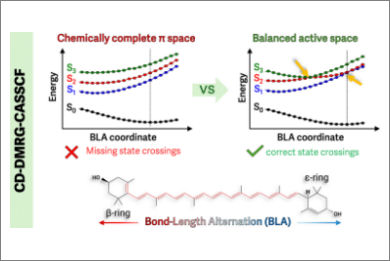
Our new paper, published in Physical Chemistry Chemical Physics, presents a CD-DMRG-CASSCF implementation that combines the Cholesky decomposition (CD) of the two-electron integrals with the density matrix renormalization group (DMRG) method as a full-CI solver. By reducing memory requirements and computational cost, the method enables CASSCF calculations with substantially larger and more flexible active spaces.
We apply this approach to lutein, a xanthophyll carotenoid whose photophysics involves a delicate interplay between bright and dark low-lying excited states. Through potential-energy curves along the bond-length alternation coordinate, we demonstrate that the choice and composition of the active space are crucial: the chemically complete CAS(20,20) π space provides an unbalanced description of the excited-state manifold, whereas including appropriate higher-lying π* orbitals recovers the expected electronic characters and state crossings.
Although the excitation energies remain qualitative without dynamic correlation, CD-DMRG-CASSCF reliably describes the ordering and nature of lutein’s lowest excited states. Our study highlight both the potential and current limitations of large-scale multiconfigurational calculations for conjugated chromophores, while motivating future developments that incorporate dynamic correlation and environmental effects.
Giannì, I., Amovilli, C., Lipparini, F. & Pedraza-González, L.
Can CASSCF model the excited states of xanthophyll lutein? A density matrix renormalization group journey
Phys. Chem. Chem. Phys. (2026)
DOI: 10.1039/D6CP02191C
Read the full paper at: https://pubs.rsc.org/cp/article-abstract/doi/10.1039/d6cp02191c/1294291/Can-CASSCF-model-the-excited-states-of-xanthophyll?redirectedFrom=fulltext
