
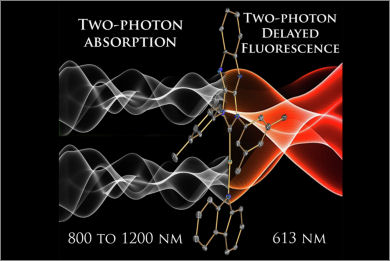
Advanced photonic materials showing two-photon absorption (2PA) have been widely explored to develop three-dimensional imaging, micro and nanofabrication, all-optical switching, lithography on a nanoscale and many other enabling technologies. These all require nonlinear absorption chromophores with intrinsic 2PA cross-sections and long-term photo- and thermal stability. Here, we disclose the very first example of the dipolar carbene-metal-amide (CMA) material showing a enhanced 2PA cross-section up to 105 GM. Overall molecular design considerations such as extended π-conjugation (to increase polarizability), minimizing the singlet-triplet energy gap (ΔEST), and using heavy metal atoms are the first design principles to obtain bright one- and two-photon excited thermally activated delayed fluorescence (TADF) material, showing one of the highest radiative rate of 2.18·106 s-1 across CMA materials. Bright red CMA 2P-TADF material shows excellent photostability (LT50 = 3 h) to 20 mW femtosecond pulsed laser excitation at 1000 nm, encouraging further CMA exploration for future applications in advanced photonic technologies requiring third-order nonlinear optical properties.
Nwosu, I.D. Matasović, L. Ramos, T.N., Le Phuoc, N., Londi, G., Gillett, A.J., Toolan, D.T.W., Smith, C.T., Whitehead, G.F.S., Blanchard-Desce, M., Daniel, J., Linnolahti, M., Olivier, Y. & Romano, A.S.
Enhanced third-order optical nonlinearity in a dipolar carbene-metal-amide material with two-photon excited delayed fluorescence
Communications Chemistry (2026)
Read the full paper at: https://www.nature.com/articles/s42004-026-01928-5
