
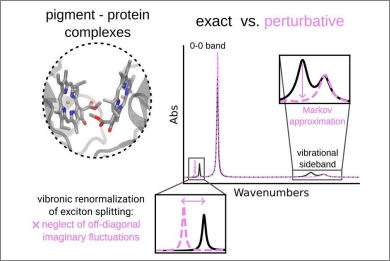
Modeling optical spectra of pigment–protein complexes requires capturing the interplay between excitonic and vibronic dynamics, a challenge amplified in multichromophoric systems. In our latest study, we benchmark several approximate lineshape theories against numerically exact HEOM calculations, using chlorophyll dimers in WSCP and the multichromophoric antenna complex CP29. We show that the well‑known suppression of vibronic sidebands originates primarily from the Markov approximation applied to off‑diagonal system–bath couplings, rather than from the perturbative order of the theory. Non‑Markovian cumulant approaches accurately reproduce vibronic intensities and exciton–vibration renormalization, while Markovian methods underestimate vibronic features and over‑broaden the main band. Fluorescence spectra are even more sensitive to these approximations, motivating the development of new equations for efficient non‑Markovian fluorescence calculations. Overall, this work defines the reliability range of approximate lineshape theories and clarifies when more accurate treatments are required for interpreting PPC spectra.
Saraceno, P.; Bhartiya, A.; Seibt, J.; Renger, T.; Kramer, T. & Cupellini, L.
Evaluation of approximate lineshape theories for photosynthetic light-harvesting antennae
The Journal of Chemical Physics, 164, 044119 (2026)
Read the full paper here: https://doi.org/10.1063/5.0310361
