
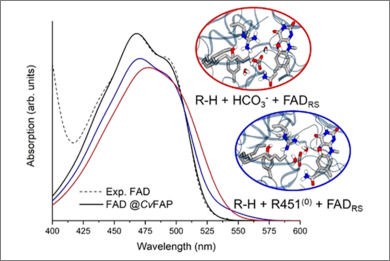
Fatty acid photodecarboxylase (FAP) is a photoenzyme that converts fatty acids into hydrocarbons through light-driven radical chemistry. Although the early photochemical steps have been elucidated, the molecular mechanism governing the catalytic termination remains unresolved. Here, we address this issue through a multiscale computational investigation based on explicit dynamic simulations of the reactive processes through a combination of classical and polarizable QM/MM strategies. Our results indicate that, following rapid decarboxylation, the resulting alkyl radical is predominantly quenched via a proton-coupled electron transfer mechanism mediated by the protonated arginine R451 and nearby water molecules. In contrast, water-assisted bicarbonate formation is found to be a rare event at room temperature, consistent with recent experimental observations. Furthermore, calculated absorption spectra demonstrate that distinct active-site configurations, either involving a neutral R451/water network or the presence of bicarbonate, can both account for the transient red-shifted flavin species FADRS observed experimentally. Overall, these findings provide a coherent and unified molecular picture of the catalytic termination in FAP and emphasize the key roles played by active-site heterogeneity and water dynamics in controlling photoenzymatic reactivity.
Londi, G. & Mennucci, B.
Molecular Mechanism of the Catalytic Radical Termination in Fatty Acid Photodecarboxylase
Journal American Chemical Society (2026)
Read the full paper at: https://doi.org/10.1021/jacs.6c07143
