
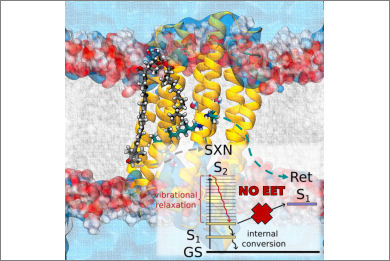
Salinixanthin, a 4-keto xanthophyll, acts as an efficient light-harvesting antenna by transferring excitation energy to retinal in the terrestrial xanthorhodopsin from Salinibacter ruber (SrXR). Although it also binds to the freshwater xanthorhodopsin Kin4B8, it does not transfer energy to retinal, whereas hydroxylated xanthophylls show high excitation energy transfer (EET) efficiency in this protein. Here, we combine molecular dynamics simulations with polarizable quantum mechanics/molecular mechanics (QM/MM) calculations to construct and characterize the Kin4B8–salinixanthin complex. We obtain a spectroscopically consistent binding model that reproduces the Kin4B8–salinixanthin experimental absorption and circular dichroism spectra and reveals strong electronic coupling between salinixanthin and retinal, comparable to the other xanthophylls. However, energy transfer is strongly suppressed by the red-shift of salinixanthin S2 state and its large reorganization energy, which drastically reduce donor–acceptor spectral overlap. These results demonstrate that, in this system, donor vibronic relaxation, rather than geometry or electronic coupling, is the decisive factor suppressing EET.
Salvadori, G., Saraceno, P., John, C., Cupellini, L., & Pedraza-González, L.
Vibronic Reorganization Suppresses Salinixanthin-to-Retinal Energy Transfer in the Freshwater Kin4B8 Xanthorhodopsin
J. Phys. Chem. Lett. (2026)
Read the full paper here: https://pubs.acs.org/doi/10.1021/acs.jpclett.6c00507
